
The Charon - Piston Powered
by Kein Anderer
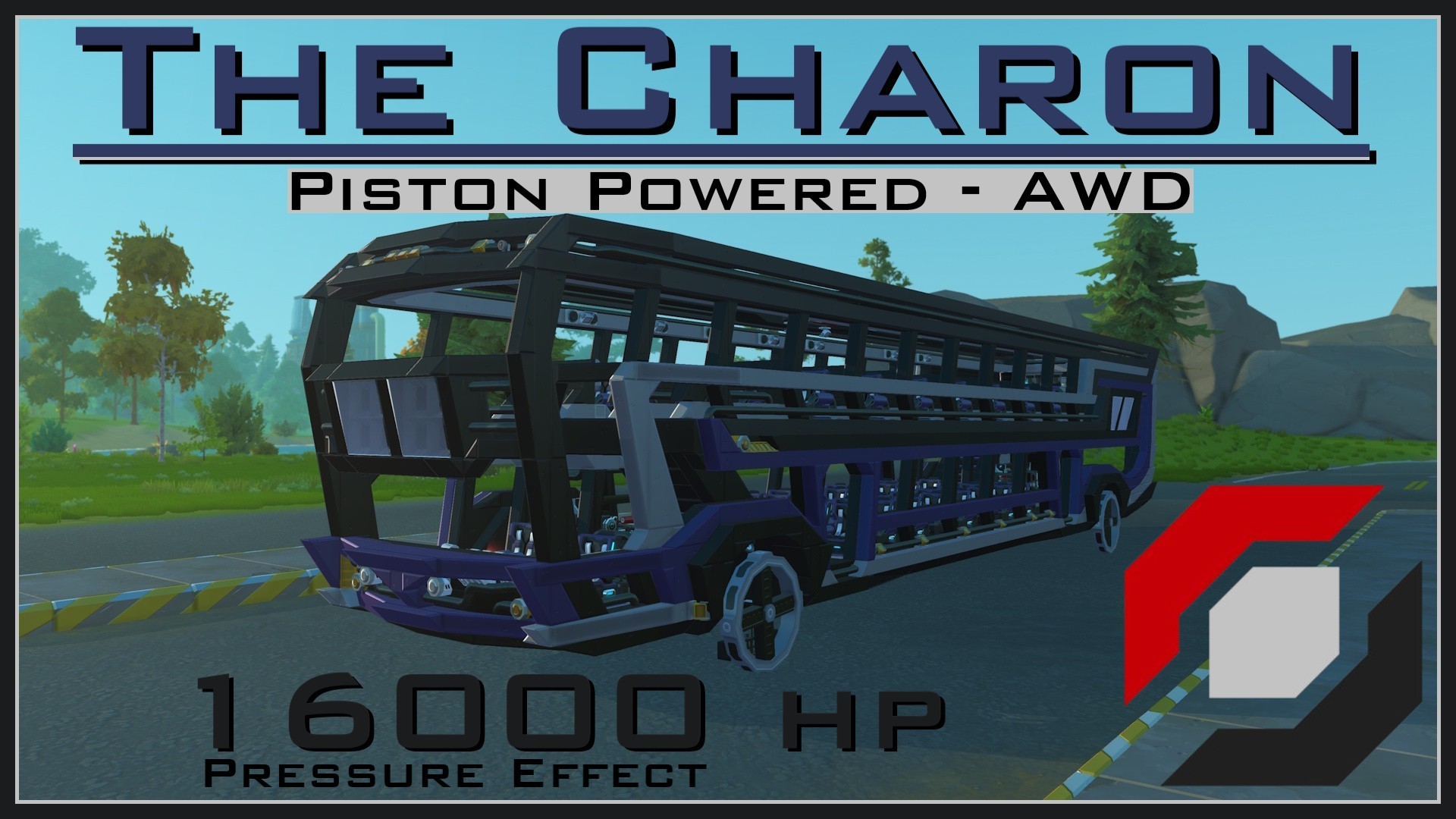
FULLY VANILLA - SMART OR ADVANCED PHYSICS RECOMMENDED Top Speed: ~340-350km/h Average Peak Rotational Speed: ~1255rpm (Wheels & Engine) Combined Peak Torque: ~92000Nm* (Wheels) Combined Peak Power: ~16000hp* (Wheels) *Due to the nature of how it compromises advanced physics effectively into partial low physics as it drives, recreating those exact physics with it on the dyno is next to impossible, so its theoretical maximum has been taken on low physics purely limited by clutch torque. The engines numbers would be quite irrelevant as low physics can shoot those up significantly higher then you would expect on advanced. Gotta love how great the physics of this game are. Overview: For the 1 guy who has seen some pressure power busses pretty much a year ago and since then waited for mine, well the wait is now finally over. As my latest pressure power build had to be a bit more conservative top speed and power wise compared to what I planned, this is a good way to offset it. It's also a good way to showcase how much power pressure engines can make. Introducing the meme high speed high power double decker bus build that comes with a bar, a toilet, 2 class seating with first class getting individual screens and even cupholders (wow, such luxury). It comes at a hefty ~16 tons, reason why it needs so much power to go fast. Sadly it can't push high cornering speeds on a racetrack with its high center of mass, so just drag racing will have to do (ik very disappointing, I wanted to do high speed racing in my double decker bus too). Controls Driver: W/S - Forward/Reverse 1 - Parking Brake [Manual Toggle, Hold for launch control 2 - Exterior Lights [Hold for high beams & fog lights 3 - Interior Lights 4 - Left Indicator [Manual, Indicates Letting Off Passengers 5 - Right Indicator [Manual, Indicates Letting Off Passengers 4+5 - Hazard Lights 6 - Exterior Number Displays 7 - Cycle Number Place [For Display 8 - Cycle Number Value [For Display 9 - Radio 10 - Horn Controls Passenger: 1 - Individual Light [Similar To Passenger Ceiling Lights In IRL Busses Lighting Overlay: Red Light - Parking Brake Orange Lights - Engine Starting [Left Green Lights - Engine Direction Indicator [Explained Further Under Launch Control Parking Brake: It will normally be managed fully automatically by the vehicle, disengaging as you press W or S and engaging as you leave the seat. It can also be manually controlled with a button and the interior & exterior light red lights indicate if its on or off. This can be useful for parking on a hill while in the seat for example. DISCLAIMER: This vehicle uses logic gates attached to the seat to detect you and for some stupid reason SM removes those, if you reload the world with the vehicle in it. This is why you get the manual button and the indicators in the first place. Launch Control: With how slow engine starts can be at times and with the bus never knowing in which direction you wanna start, this has received some now dusty and almost forgotten technology from one of my older piston cars. Hold 1 (flashing red light), press either W or S depending in which direction you wanna launch (yes reverse launches included ofc) and then let go of 1 if the green lights are on. The green lights under the dashboard indicate if the engines are running and in which way (left side = forward, right side = backward). Exterior Number Displays: Busses irl offer exterior displays to show you various data like the start and destination, aswell as the bus line. I brought a small piece of that to this bus with its fully customizable 4 digit displays. Due to how large displays are in this game, it has to be limited to just 4 digits and despite this is still quite massive. What Are Pressure Engines?: The main principle behind these is the way the pistons provide power. Instead of using the pistons power from a logix input, they use joint compression under high speeds (aka what we call the "pressure effect"). This gives very significant power benefits (going well into the 1000s for hp/piston) which is easily over 30-100 times higher than what your conventional engines can do at most. Due to not needing timing, nor being speed capped in any other way they will synchronize to the games tickrate with most examples (including the ones on this build) running at ~1255rpm, which is very much sufficient for most application and allows for high speed vehicles with that high power at the top end, which is basically unheard of with any timed engine design. They do come with a relatively large weight penalty and require blueprint edited controllers to speed up the pistons (still spawnable in vanilla btw), but are still very much worth it overall. Here is a video to explain pressure engines in further detail if you're interested: https://youtu.be/YULRhRh3ehw?si=PYkpQuvkrQOXts5t The Engines Explained: Similiar to my other builds it uses a type of engine with the geometry of effectively a scotch yoke boxer 2 design with a flywheel to increase power consistency. Blueprint edited pistons are used to create frictionless sliders on 1 axis while being able to provide power on its normal axis. At the current point it has become the most mainstream pressure engine design in our community for its mechanical simplicity, inherent balance, low complexity and higher power efficiency. Its AWD Drivetrain: Unlike all my other pressure power builds made until now, this is direct drive and does not use any form of transmission. This is primarily for the sake of reducing drivetrain complexity that it would have normally needed for the power it transfers. Unfortunately this does also introduce some limits, like its top speed never being able to exceed 400km/h (this is relatively far from it but still), engine torque and flywheel precession not being balanced within the vehicle and reverse requiring an engine restart with it being able to run in 2 directions. To make switching between forward and reverse much faster with a lower complexity starter, while also offering a lower complexity form of braking, it uses a vacuum pump to place sand on the engine subframe to break the pistons mass rule and make the engine stall as the degrees of freedom on the wonky pistons are removed. This can be a way to have engine braking as is or a spudgun can be used additionaly to break the block and having the starter start it the other way for reverse. Besides this, its just utilizing clutches on each end of both axles for throttling and torque vectoring. Similar to my truck, it is running a rear torque bias of 35/65 front/rear that's more ideal under acceleration. The Wonky Clutch, CV-Joint & Suspension: To still give it fully independent suspension and steering, you would usually need quite a complex and large assortment of u-joint driveshafts, but not if you utilize wonky bearings with their degrees of freedom on a plane orthogonal to their axis of rotation. Using 1 of these on each wheel allows for an easy power transfer that can move vertically for suspension, aswell as being able to allow rotation for steering at the same time (the geometry is even very much near a constant velocity joint). Using 2 or more bearings to make them double bearing clutches adds a full torque vectoring and throttling system on top of that. All the torque- and power numbers have been measured with a dyno, here is a link of mine and Ben's: https://steamcommunity.com/sharedfiles/filedetails/?id=2959348546 If you are interested in a sm community for the more technical minded, you can check out this discord server: https://discord.gg/6r46PkYr9s Tags: cargo, utility, fast, coach, heavy duty, 4x4, four wheel drive, all wheel drive, kein engine, pressure engine, piston engine
Comments
0 total- No comments yet. Be first.