
The Zenith GTS - Piston Powered
by Kein Anderer
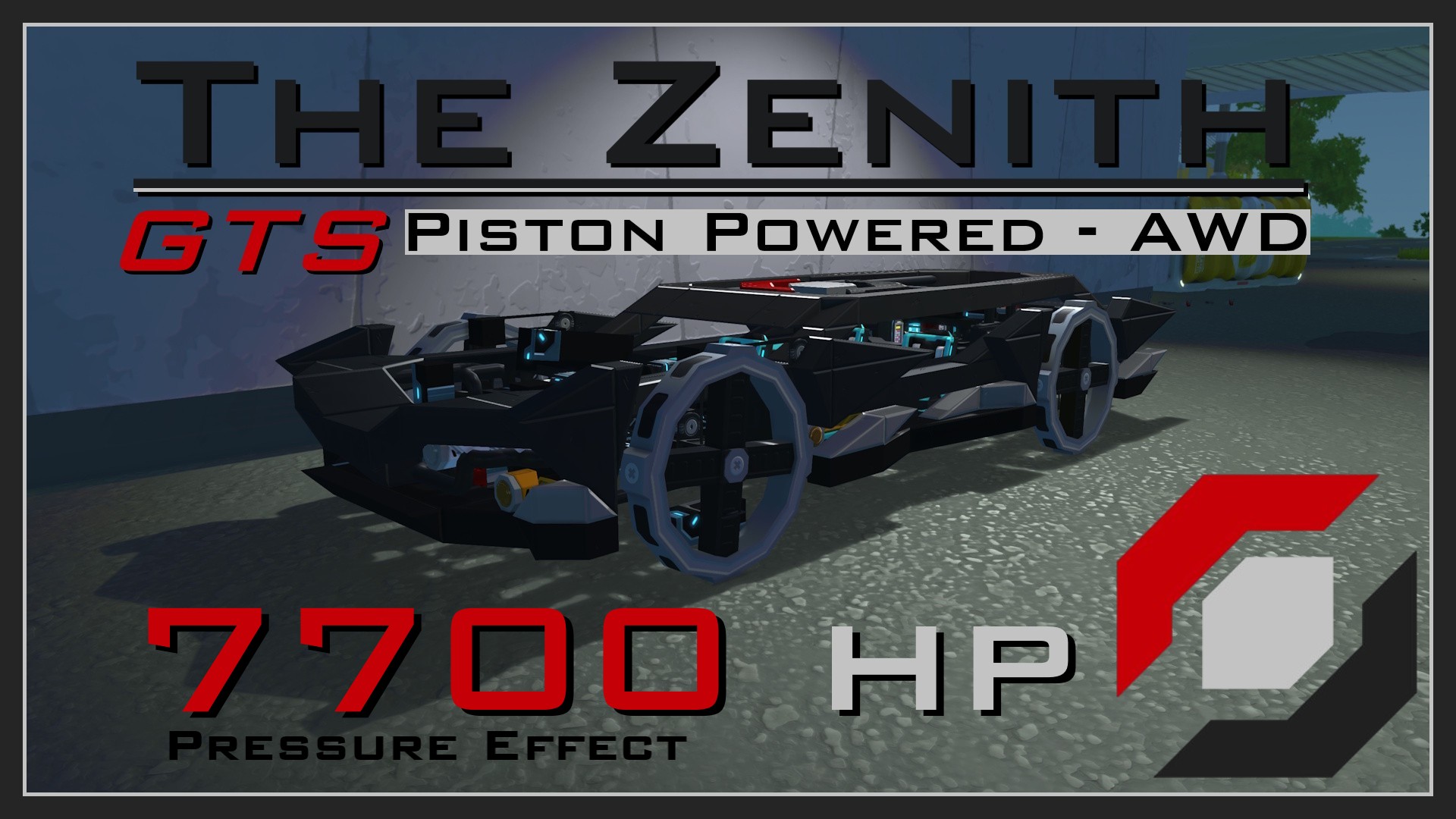
FULLY VANILLA - ADVANCED PHYSICS RECOMMENDED Top Speed: ~600km/h Average Peak Rotational Speed: ~2300rpm (Wheels), ~1254rpm (Engine) Combined Peak Torque: ex. 32000Nm (Wheels), ~66000Nm (Engines) Combined Peak Power: ~7700hp (Wheels), ~11600hp (Engines) 0-100km/h Time: 0.77s XXXL Track 2 Lap Time: 2:22 - Track Link: https://steamcommunity.com/sharedfiles/filedetails/?id 2 - Top Speed Mode 3 - Offroad Mode 4 - Torque Vectoring Lock 5 - Lights [Hold for high beams 6 - Hazard Lights 7 - Radio 8 - Horn Parking Brake: It will normally be managed fully automatically by the vehicle, disengaging as you press W or S and engaging as you leave the seat. It can also be manually controlled with a button and the interior & exterior light red lights indicate if its on or off. This can be useful for parking on a hill while in the seat for example. DISCLAIMER: This car uses logic gates attached to the seat to detect you and for some stupid reason SM removes those, if you reload the world with the vehicle in it. This is why you get the manual button and the indicators in the first place. Offroad Mode: This mode raises the cars ride height by 1 block, which is useful to get over difficult terrain bits or unstuck. As the torque vectoring doesn't fully open anymore, it can work offroad just fine too. What Are Pressure Engines?: The main principle behind these is the way the pistons provide power. Instead of using the pistons power from a logix input, they use joint compression under high speeds (aka what we call the "pressure effect"). This gives very significant power benefits (going well into the 1000s for hp/piston) which is easily over 30-100 times higher than what your conventional engines can do at most. Due to not needing timing, nor being speed capped in any other way they will synchronize to the games tickrate with most examples (including the ones on this build) running at ~1254rpm, which is very much sufficient for most application and allows for high speed vehicles with that high power at the top end, which is basically unheard of with any timed engine design. They do come with a relatively large weight penalty and require blueprint edited controllers to speed up the pistons (still spawnable in vanilla btw), but are still very much worth it overall. Here is a video to explain pressure engines in further detail if you're interested: https://youtu.be/YULRhRh3ehw?si=PYkpQuvkrQOXts5t The Engines Explained: Similiar to the Zenith it uses a type of engine with the geometry of effectively a scotch yoke boxer 2 design with a flywheel to increase power consistency. Blueprint edited pistons are used to create frictionless sliders on 1 axis while being able to provide power on its normal axis. At the current point it has become the most mainstream pressure engine design in our community for its mechanical simplicity, inherent balance, low complexity and higher power efficiency. The "Wonky Bearing" Transmissions & AWD: Another big piece of technology this car has are its transmissions. Any transmission you know of is most likely dependent on collisions, which makes them non viable for this kind of power and for these speeds. By using 2 axles perpendicular to eachother with a blueprint edited bearing (aka what we call a "wonky bearing") inbetween, you can create a fully collisionless transmission that can have any ratio you want, including negative ones. This build specifically is running a CVT per axle that can on top of that variably adjust its ratio. Pressure engines offer no throttling naturally, no engine braking and are hard to start in either direction quickly. The transmissions fix all of these issues naturally and allow for a very easy to drive and versatile drivetrain. As these engines create high power, their torque will also be quite high and would usually require a quite crazy torque compensation system, but not if you can make the second engine counterrotate. As I am already using 2 engines for AWD (1 per axle), this makes this quite easy to do and allows for very low power torque compensation with just weight to be sufficient, like on a gas car with equivalent power. The Wonky Clutch, CV-Joint & Suspension: To still give it fully independent suspension and steering, you would usually need quite a complex and large assortment of u-joint driveshafts, but not if you utilize wonky bearings with their degrees of freedom on a plane orthogonal to their axis of rotation. Using 1 of these on each wheel allows for an easy power transfer that can move vertically for suspension, aswell as being able to allow rotation for steering at the same time (the geometry is even very much near a constant velocity joint). Using 2 bearings to make them double bearing clutches adds a full torque vectoring and throttling system on top of that. Artificial Downforce: All wheels in this game have effectively a terminal velocity they can provide with their natural traction on normal ground types, as extra weight that would aid in traction also adds to drag in just the same way, making both cancel eachother out. There is a way to effectively add extra traction by having very specific suspension geometry and stiffness though, which this vehicle is using to a similiar extend compared to the standard zenith. This car would only be able to reach ~380km/h if you would maximize natural traction as much as possible, more realisticly you would be below that even. This method is fairly plug and play as it can just exist on the vehicle with no extra world connection or stuff that has to drop out of the car. Supension Features: With the way artificial downforce wants to exist, you are effectively forced to have your suspension as soft as it can be, which is gonna be horrible on normal terrain and while cornering with the games nonexistant dampening. If you dont enjoy ziplock water bag like handling, that means some extra tech is needed. These include a form of dampening system and an anti roll bar. The dampening is done with blueprint edited bearings that have 0 resistance at lower bump speeds and higher resistance at higher bump speeds, kind of like an inverted friction dampener. Only needs 2 extra bearings per suspension arm and its 2 settings are sufficient with the little suspension travel this car has. The anti roll bar is basically just an extra bearing connecting the rear suspension arms fix a fixed stiffness to have them only move independently under strong bumps, keeping the rear end a lot flatter in corners. The standard Zenith had neither of those, which is the reason why its top speed mode was far more compromised. All the torque- and power numbers have been measured with a dyno, here is a link of mine and Ben's: https://steamcommunity.com/sharedfiles/filedetails/?id=2959348546 If you are interested in a sm community for the more technical minded, you can check out this discord server: https://discord.gg/6r46PkYr9s Tags: sports car, luxury car, sports car, hypercar, estate, station wagon, all wheel drive, kein engine, pressure engine, piston engine
Comments
0 total- No comments yet. Be first.