
The Photon - Performance Flyer
by Kein Anderer
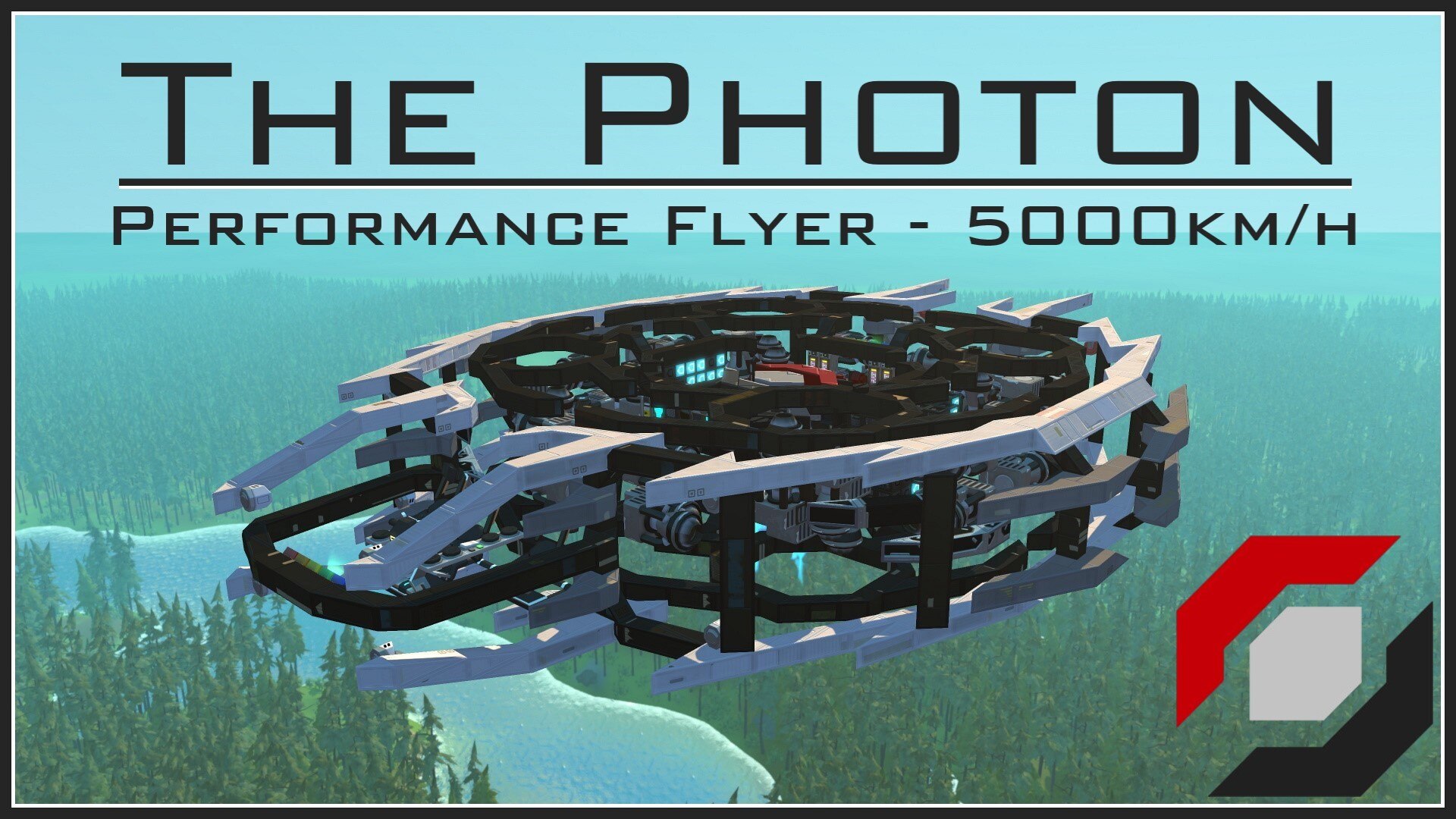
FULLY VANILLA - Top Speed: ~5000km/h FREE OF SUSPENSION GLITCHES Introduction: Most flyers youll find on the workshop push speeds up to 200, 300 maybe 400 or 500km/h at most. Occasionally offering features like a gyro and most of the time relying on suspension glitches for its core features, even if its just in the gyro. This flyer is very different. The Pulsar I made a while ago did already try a lot of what this flyer does, but this offers more in basically every way. Much higher top speeds, even up to double in certain directions, more refined inertia control, strafing and optional gyro stabalizaion that the Pulsar never got with a body design that is far more balanced for handling with much smaller semi major axis effects to even be able to push its rotational speeds. All of this while still trying to keep mechanical complexity and thrustcount as low as possible relatively speaking (reason why its using a full cardboard body). One more interesting thing to note is that this flyers top speed is quite close to the terminal velocity of old thrusters (being at ~6500km/h) and over the terminal velocity of the level 5 thrusters (being at ~4300km/h), which barely any flyer on the workshop does, at least currently. Controls: W/S - Foward/Backward Thrust A/D - Yaw 1/2 - Roll 3/4 - Pitch 1+2 - Positive Lift 3+4 - Negative Lift (Suggest that you set up a second WASD set for roll & pitch) 5 - Main Power On/Off 6 - Strafing Left 7 - Strafing Right 8 - Power Mode Selector (fastest by default) 9 (short push) - 50% Power Toggle (off by default) 9 (long push) - Gyro Stabalization Toggle (off by default) 10 - Lights In our flyer community the buttons 1-5 (+6&7 here) are standardized for anyone who was wondering about those. Any higher performance flyer I have will use these. Power Modes: This flyer has 3 different power modes, primarily to make lower speed flight & manouvering easier. These are indicated by the 3 lights infront of the driver or on top of the flyer (for third person). Mode 3 (Orange): This mode disables all mechanical vectoring and only enables thrusters that are already facing the right direction for everything. Its the most useful mode to do tiny adjustments midair if youre spectating etc. Expect ~15% of its maximum power here at most. Mode 2 (Yellow): This disables half the mechanical vectoring for foward thrust and makes roll and pitch purely electronic. Mechanical yaw is retained. Expect ~51% of its maximum power here at most. Mode 1 (Green): This enables all vectoring to push the highest speeds everywhere. 50% Power Toggle: This lets you quickly toggle between 100% and 50% power for all the thrust in every power mode, to effectively double the power modes to a total of 6 and have a way to adjust this thats a bit quicker to toggle. Lighting Overlay Description: Green, Yellow, Orange Lights - Power Modes Blue Light - Gyro Stabalization Red Light - 50% Power Toggle Performance Overview: Speeds Table: [table [tr [thTranslation/Rotation Direction[/th [thSpeed - Mode 1[/th [thSpeed - Mode 2[/th [thSpeed - Mode 3[/th [/tr [tr [tdForward[/td [td~5000km/h[/td [td~2570km/h[/td [td~750km/h[/td [/tr [tr [tdBackward[/td [td~600km/h[/td [td~600km/h[/td [td~600km/h[/td [/tr [tr [tdPositive Lift[/td [td~1210km/h[/td [td~1210km/h[/td [td~600km/h[/td [/tr [tr [tdNegative Lift[/td [td~1210km/h[/td [td~1210km/h[/td [td~600km/h[/td [/tr [tr [tdStrafing Left & Right[/td [td~600km/h[/td [td~600km/h[/td [td~600km/h[/td [/tr [tr [tdYaw[/td [td~50rpm[/td [td~50rpm[/td [td~32rpm[/td [/tr [tr [tdRoll[/td [td~52rpm[/td [td~52rpm[/td [td~28rpm[/td [/tr [tr [tdPitch[/td [td~42rpm[/td [td~42rpm[/td [td~21rpm[/td [/tr [/table Technology Overview: Rotational Inertia Control & Speed Limiters: A pretty standard piece of tech with performance flyers in our community, that automatically decelerates a rotational axis and that can also be used to limit a rotational top speed. For roll & pitch it makes use of 2 39 block diameter rotors, that only weigh ~110kg combined. Their gyroscopic precession is what decelerates it automatically, aswell as limiting top speed combined with the chosen amount of thrust. For yaw it makes use of a "deflection sensor" similiar to the Pulsar, which is a smaller spinning disc that uses sensors to pick up yaw speeds in my case and use the yaw thrusters for deceleration. Its more lightweight then rotors, but not as ideal with the deadzone and linearity (at least with my electronic setup). On yaw its fairly forgiving and much higher performance then rotors, reason why I use it here. Mechanical Vectoring: Just like the Pulsar, this uses controller bearings & clutches to reorient the thrusters to make their power usable in multiple directions and not just 1 fixed one. This is also the main feature that enables such a high forward thrust top speed, with it being at ~98% total thrust utilization. Its high thrustcount did require the thrusters to be more compressed for lower rotational inertia and the vectoring itself to be higher power compared to the Pulsar. Gyro: Also very similiar to the Pulsar with its concept, this gyro uses a ball joint instead of the more traditional stacked bearings setup, which makes it significantly more balanced and reliable at any angle. The gravity compensation thrust is also mounted inside to make it feel like youre in a 0g environment at any angle and new for this flyer is additional gyro stabalization for roll & pitch that you can toggle on or off, if you want it. Should also point out that this flyer has full low physics compatability, as its not using springs or anything else that would compromise it. Even the gyro can handle it quite well. If you are interested in a sm community for the more technical minded, you can check out this discord server: https://discord.gg/6r46PkYr9s Tags: Aircraft, Spaceship, Fast, Speed, Handling, VTOL, Futuristic, Sci-Fi, Mach
Comments
0 total- No comments yet. Be first.